

HSE University to Host BRICS International School: New Generation
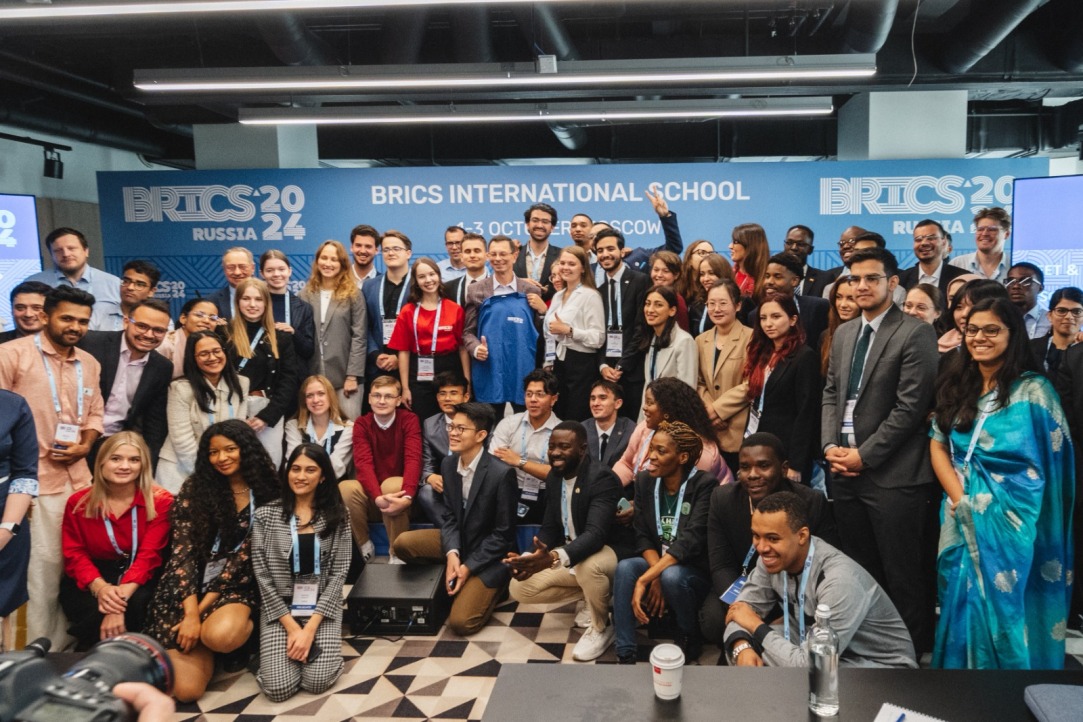
Registration for the BRICS International School: New Generation, one of the leading international educational projects aimed at prospective leaders interested in the agenda of global development and cooperation within the framework of BRICS, has opened.
This autumn, HSE University will host 100 prospective leaders participating in the BRICS International School: New Generation. The school is held annually with the support of the Russian Ministry of Foreign Affairs, while the BRICS Expert Council–Russia established at HSE University operates as its intellectual and organisational centre. HSE's participation in the project provides in-depth academic expertise, as well as systematic support for prospective BRICS experts.

Victoria Panova
The BRICS International School: New Generation is not limited to the educational format. It has become a platform for establishing a new, more just, and inclusive world order. Today, BRICS is not only an economic association, but above all, a vibrant community of people ready to interact on equal terms and learn from each other. That is why the formats that bring together young people, experts, and researchers have become so important. HSE University, as one of the leading research and educational platforms, plays a key role in this process: we not only support the project academically, but also support its development as an institute for international dialogue among a new generation. We are proud that the school has already become a point of attraction for young leaders from dozens of countries around the world and continues to develop as BRICS expands,’ said Victoria Panova, HSE University Vice Rector and Head of the BRICS Expert Council–Russia.
Following the expansion of the BRICS association in 2025, the project is entering a new stage of development. The school is focused on building a community of young leaders and promoting a positive BRICS agenda. It focuses on expanding the pool of experts capable of working in the field of global governance, international relations, economics, and humanitarian cooperation.
The project history dates back to 2017, when Russia began to conduct the first short-term educational programmes on cooperation between the BRICS countries for students and prospective scientists. Eight years later, the project has become a global movement that attracts participants from all over the world. School graduates become BRICS ambassadors and form a new global community.

Raymond Matlala
‘We need to remember that when we invest in the younger generation, we not just invest in the development of specific people—we invest in our future. As the saying goes, “less talk, more action.” And this is exactly what HSE University and the BRICS Expert Council–Russia do. I admire this approach, and I would like to encourage the leaders of other BRICS countries to invest more actively in young people,’ says Raymond Matlala, founder and chairman of the South African BRICS Youth Association, Chairman of Y20, participant of the BRICS International School 2017.
The intensive educational programme features lectures by leading Russian and international specialists, master classes, business games, debates, and expert discussions. The school provides an opportunity to thoroughly study the mechanisms of interaction between the BRICS countries, their positions in the system of international relations, their role in shaping the new world order and the prospects for the institutional development of the association.
Prospective scientists and innovators, diplomats, representatives of relevant ministries and departments, research centres and civil society, political scientists, entrepreneurs, international journalists, and leaders of youth movements aged 18 to 35 are invited to participate in the project. The organisers provide accommodation, meals, and transfers as part of the programme. Participants pay for travel to and from the school venue, as well as visa and medical insurance costs.
Applications are open until September 15.
The selection of participants is carried out on a competitive basis.
Dates: autumn 2025
Location: Moscow, Russia
Format: on-site
Language: English
More detailed information can be found on the project's website.
See also:

HSE Scientists Optimise Training of Generative Flow Networks
Researchers at the HSE Faculty of Computer Science have optimised the training method for generative flow neural networks to handle unstructured tasks, which could make the search for new drugs more efficient. The results of their work were presented at ICLR 2025, one of the world’s leading conferences on machine learning. The paper is available at Arxiv.org.
Neural Network Trained to Predict Crises in Russian Stock Market
Economists from HSE University have developed a neural network model that can predict the onset of a short-term stock market crisis with over 83% accuracy, one day in advance. The model performs well even on complex, imbalanced data and incorporates not only economic indicators but also investor sentiment. The paper by Tamara Teplova, Maksim Fayzulin, and Aleksei Kurkin from the Centre for Financial Research and Data Analytics at the HSE Faculty of Economic Sciences has been published in Socio-Economic Planning Sciences.
‘To Help Make the World More Sustainable, Fair, and Humane’
The BRICS International School: New Generation has concluded at HSE University, bringing together more than 100 participants from 38 BRICS and Global South countries. The attendees included early-career researchers, diplomats, entrepreneurs, journalists, and civil society representatives.
Larger Groups of Students Use AI More Effectively in Learning
Researchers at the Institute of Education and the Faculty of Economic Sciences at HSE University have studied what factors determine the success of student group projects when they are completed with the help of artificial intelligence (AI). Their findings suggest that, in addition to the knowledge level of the team members, the size of the group also plays a significant role—the larger it is, the more efficient the process becomes. The study was published in Innovations in Education and Teaching International.
Advancing Personalised Therapy for More Effective Cancer Treatment
Researchers from the International Laboratory of Microphysiological Systems at HSE University's Faculty of Biology and Biotechnology are developing methods to reduce tumour cell resistance to drugs and to create more effective, personalised cancer treatments. In this interview with the HSE News Service, Diana Maltseva, Head of the Laboratory, talks about their work.
Master’s Students of HSE, University of Campinas, and Tsinghua University Publish Joint Student Research Collection
Master’s students of the HSE ISSEK programme ‘Science, Technology and Innovation Management and Policy’ have released a joint research collection with the University of Campinas (Brazil) and Tsinghua University (China) titled ‘Being Innovative or Being on the Safe Side—Managing the Risk of Failure.’ The authors explore how organisations perceive risks and embrace innovation within different cultural contexts.
‘A Turn Away from Stereotypes’: Moscow Hosts ‘Researching the Deaf Community’ Conference
On October 17–19, 2025, the third annual interdisciplinary conference ‘Researching the Deaf Community 2025: on the Periphery of Attention’ took place at GES-2 House of Culture in Moscow. The event was organised with the participation of the HSE International Laboratory for Social Integration Research. HSE University Vice Rector Irina Martusevich addressed attendees at the opening ceremony.
Exploring the Mind: HSE Scientists Discuss Cognitive Technologies of the Future
Why we make irrational decisions, how the brain responds to fakes, and whether neural networks are capable of thinking—these were the topics discussed by early-career scientists of HSE University during the NAUKA 0+ science festival. The event brought together students and experts from various fields, united by a common goal—to deepen their understanding of the human brain and cognitive technologies.
HSE Researchers Assess Creative Industry Losses from Use of GenAI
Speaking at the IPQuorum.Music forum on October 15, Leonid Gokhberg, HSE First Vice Rector, and Daniil Kudrin, an expert at the Centre for Industry and Corporate Projects of HSE ISSEK, presented the findings of the first study in Russia on the economic impact of GenAI on creative professions. The analysis shows that creators’ potential losses could reach one trillion roubles by 2030.
International Dialogue on Urban Development: Dynamic Urbanism and Green Infrastructure
In September 2025, the HSE Faculty of Urban and Regional Development (FURD) hosted a delegation of leading scholars and urban development experts from China. Two seminars were held at the Shukhov Lab with the participation of Chinese colleagues: the first focused on green infrastructure, while the second explored the theme of dynamic urbanism. In addition, a meeting between the Chinese delegation and representatives of FURD took place at the university’s main building on Pokrovsky Bulvar. The participants discussed opportunities for expanding cooperation between universities and research centres.