

How to Build a Business in the New Reality of the Chinese Market

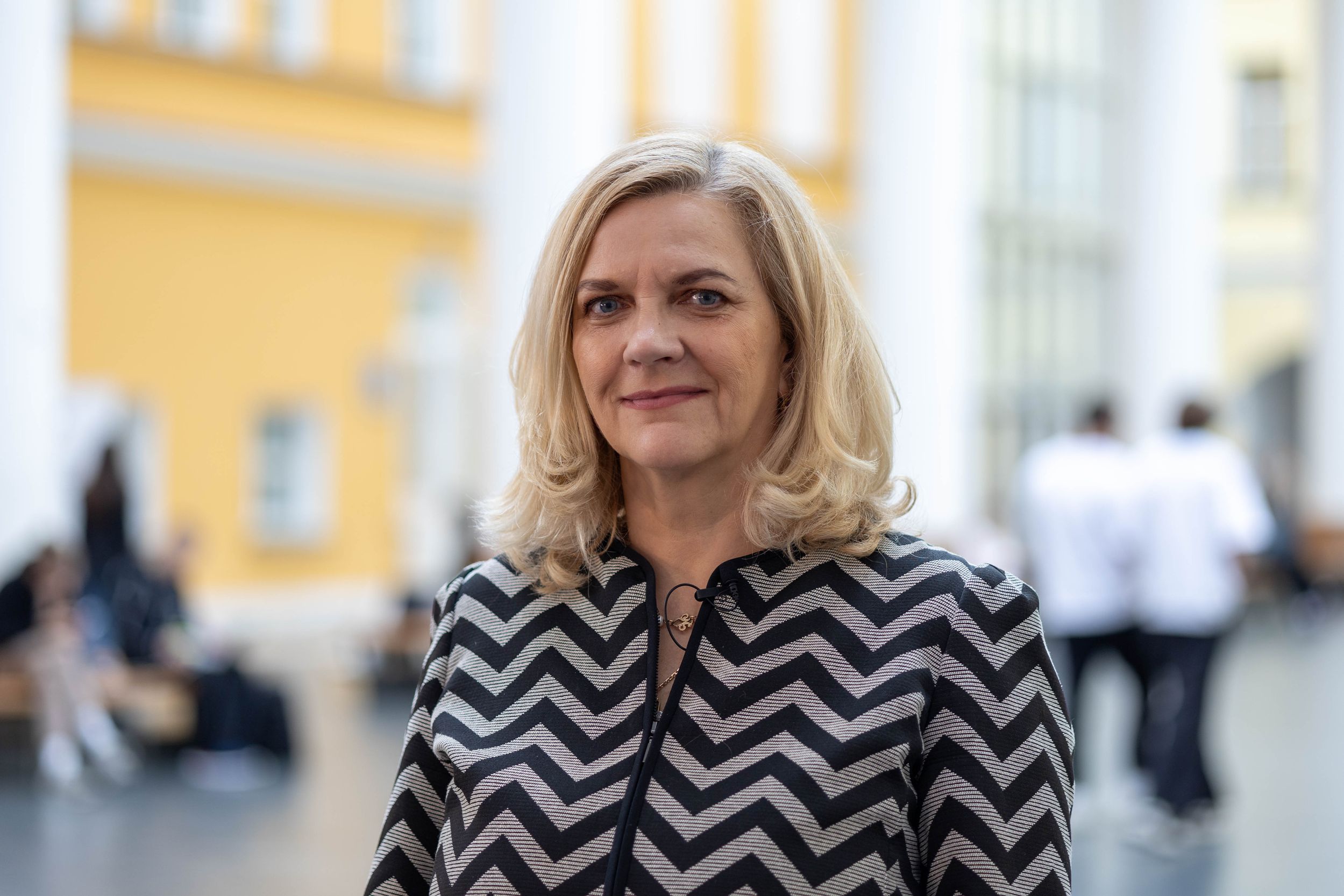
At the international SPROUTS Business Forum in Kazan, Prof. Natalya Guseva of HSE University, Head of the ‘Eastern Perspective: Doing Business in China in Practice’ educational programme for entrepreneurs and managers, delivered a keynote address entitled ‘Competing with China: Why Old Skills Are No Longer Enough’ during a Russian–Chinese business session. Her talk attracted a large audience of business representatives, exporters, and government officials.
Natalya Guseva emphasised that today, Russian companies aiming for success in China or competing with Chinese players on global markets face not merely cheap products, but entire ecosystems. These comprise ultra-rapid iteration cycles, flexible production networks, and deep digitalisation. ‘We are no longer competing with individual Chinese companies,’ she noted. ‘We are competing with their ecosystems, their speed of adaptation, and their ability to shift production instantly. Old reflexes—undercutting on price, finding a single distributor, memorising a couple of cultural rules—no longer work.’
The professor drew particular attention to three key shifts shaping the current landscape.
The first is tariff pressure. The EU has introduced definitive anti-dumping duties on Chinese electric vehicles—up to 35% on top of the basic 10%—while the United States has sharply raised tariffs on a range of Chinese goods. In particular, the so-called Section 301 tariffs (under the US Trade Act), a tool of American trade law used to restrict countries whose trade policies Washington deems harmful, have been increased to 100% on electric vehicles. Tariffs on batteries and semiconductors have also been raised, directly affecting profitability and localisation strategies.
The second shift is the China+1 strategy. This business model entails risk diversification by relocating part of production from China to other countries, most commonly in Southeast Asia or India, to avoid dependence on a single manufacturing base. Brands such as Apple are actively shifting part of their production to India and Southeast Asia, thereby creating alternative supply chains.
The third is the ecosystemisation of consumption. Without a presence on WeChat (which has 1.385 billion users) and other platforms such as Douyin, Tmall, and Xiaohongshu, a brand effectively becomes invisible.
‘Price is no longer a strategy. Victory belongs to those who scale and adapt faster,’ Natalya Guseva explained. ‘Tesla Giga Shanghai now produces more than half of the company’s global output and has already exported a million vehicles. This is not about discounts, but about rhythm, logistics, and efficiency.’
The professor presented a new set of competencies essential for competition: from ecosystem-based go-to-market strategies (GTM) and China+1 supply chain management to co-R&D with local partners, built-in intellectual property protection and digital diplomacy. She highlighted examples of successful Russian engagement: RUSAL obtained the world’s first foreign Chinese certificate for ‘green aluminium,’ opening access to environmentally conscious clients, while Russian goods in live-stream sales on Chinese platforms reach more than 100 million yuan in a single session.
Natalya Guseva urged businesses to abandon template thinking. ‘The winner is not the one who merely knows about China, but the one who can integrate China into their system—and update it swiftly,’ she concluded.
See also:

‘Analytical Centres and Programmes for PhD Students’: HSE University–St Petersburg Offers New Formats of Cooperation with PRC
The Rope Shop Educational Space of HSE University–St Petersburg hosted a conference on the present and future of Russian–Chinese relations. Together with Luo Zhanhui, Consul General of China in St Petersburg, leading experts in Asian and African Studies discussed vectors for the long-term development of the countries, the synergy of joint projects, and future educational partnerships.
Transition to Sustainable Development Requires Deep Structural Transformation of Business
A group of researchers has proposed assessing the ESG transformation of businesses through the partner turnover ratio in raw material and distribution supply chains. The researchers note that the path towards sustainability requires a deep and often costly restructuring of partner networks. This and other papers were presented at the Third International Annual Conference ‘ESG Corporate Dynamics: the Challenges for Emerging Capital Markets.’
HSE University Hosts China Academy of Art Delegation to Strengthen Academic and Research Cooperation
On December 12, HSE University welcomed a delegation from the China Academy of Art — one of the most prestigious creative universities in Asia. The visit built on the dialogue launched in September and reaffirmed the mutual interest in collaboration outlined during the visit of Natalia Logutova, Deputy Director of the HSE Institute for Creative Industries Development, to the academy’s campus in Hangzhou. The parties discussed ideas that could form the foundation for long-term partnership—from digital reconstructions of historical spaces to joint educational programmes and research initiatives.
Eighth International U4U Online Seminar Unites Experts from 14 Countries
The HSE Online Campus hosted a two-day international U4U (Universities for Universities) seminar, which traditionally serves as a platform for exchanging expertise in online learning. This year, the event has reached a global scale, attracting international experts and representatives of universities from around the world. Together, they discussed key challenges and strategies for the development of online education. The online meeting was held in mid-November.
‘Keep Working, Keep Publishing—Consistency Matters’
Ziyuan Zhu, from Beijing, China, is an international PhD student at the Institute for Public Administration and Governance at HSE University in Moscow. In this interview with the HSE News Service, Ziyuan talks about how studies can influence one’s outlook on life, comparing public service models in different countries, and why being a Chinese student in Russia is advantageous in research.
Under a Blooming Magnolia: How Russian and Chinese Scientists Create Solar Cells of the Future
Schola continues to introduce the winners of the International Academic Cooperation competition. In today's issue, Professor Andrey Vasenko, Deputy Head of the Scientific and Educational Laboratory of Quantum Nanoelectronics at Tikhonov Moscow Institute of Electronics and Mathematics (MIEM), speaks about the joint project between his laboratory and the Peking University research team— ‘Engineering of highly efficient and stable perovskite solar cells.’
Graduate School of Business MBA Students Take Part in Offsite Module in China
MBA students of the HSE Graduate School of Business HSHSE have recently completed the international component of their studies at the School of Economics and Management at Tsinghua University. The module focused on developing business through innovation. The participants discussed the impact of new technologies on corporate structures and visited companies operating in robotics and renewable energy.
Meeting with Xinhua Delegation: Discussion on Contemporary Journalism at HSE
On October 22, 2025, HSE University hosted an open meeting with representatives of the Chinese news agency Xinhua, led by Sun Zhiping, Chief of Staff to the Director General. Participants discussed current challenges in journalism and the operational specifics of news agencies in today’s media landscape. Many students took the opportunity to ask questions and practise speaking Mandarin. The visit was organised by the Faculty of World Economy and International Affairs in collaboration with the HSE Institute of Media and the TASS news agency.
HSE Participates in Conference on International Exchange of Professionals in China
From October 21 to 24, 2025, the 23rd Conference on International Exchange of Professionals took place in Shanghai and Beijing, bringing together more than 7,000 scientists and experts from around the world. HSE University was represented by Ivan Arzhantsev, Dean of the Faculty of Computer Science, and Vasily Gromov, Head of the Laboratory for Semantic Analysis of the Centre for Language and Semantic Technologies.
‘It Was Interesting to See How Our Chinese Colleagues Work’: HSE Researchers Take Part in Hefei Summer School
This summer, Diana Sukhoverkhova, Daria Mazur, and David Kagramanyan, research assistants at the MIEM HSE Laboratory for Computational Physics, spent five weeks in China. At the Future Scientist Exchange Program (FuSEP) summer school in Hefei, they worked in new fields of science together with their Chinese colleagues. HSE's promising scientists spoke to the HSE News Service about their intense and productive time in China.