

HSE Scientists Reveal How Disrupted Brain Connectivity Affects Cognitive and Social Behaviour in Children with Autism

An international team of scientists, including researchers from the HSE Centre for Language and Brain, has for the first time studied the connectivity between the brain's sensorimotor and cognitive control networks in children with autism. Using fMRI data, the researchers found that connections within the cognitive control network (responsible for attention and inhibitory control) are weakened, while connections between this network and the sensorimotor network (responsible for movement and sensory processing) are, by contrast, excessively strong. These features manifest as difficulties in social interaction and behavioural regulation in children. The study has been published in Brain Imaging and Behavior.
For a person to focus attention, move, perceive others, and regulate their own behaviour at the same time, the brain engages multiple functional networks. Each network is responsible for a specific function: attention, movement, perception, or behavioural regulation. As individuals mature, the internal connections within these networks strengthen, while the connections between different networks, by contrast, tend to weaken. This allows the brain to allocate responsibilities across its systems, so they can operate independently without interfering with one another. This process is known as network segregation.
However, in autism spectrum disorders (ASD), network segregation may be disrupted. Autism spectrum disorders are neurodevelopmental conditions that alter the way individuals perceive information, interact with others, and respond to the world around them. To understand how disruptions in brain networks relate to these changes, researchers from the HSE Centre for Language and Brain, the Institute of Linguistics of the Russian Academy of Sciences, and the Seattle Children’s Research Institute studied, for the first time, the interaction between two key networks: the cognitive control network—responsible for attention, inhibitory control, and planning—and the sensorimotor network, which is involved in movement and sensory information processing.
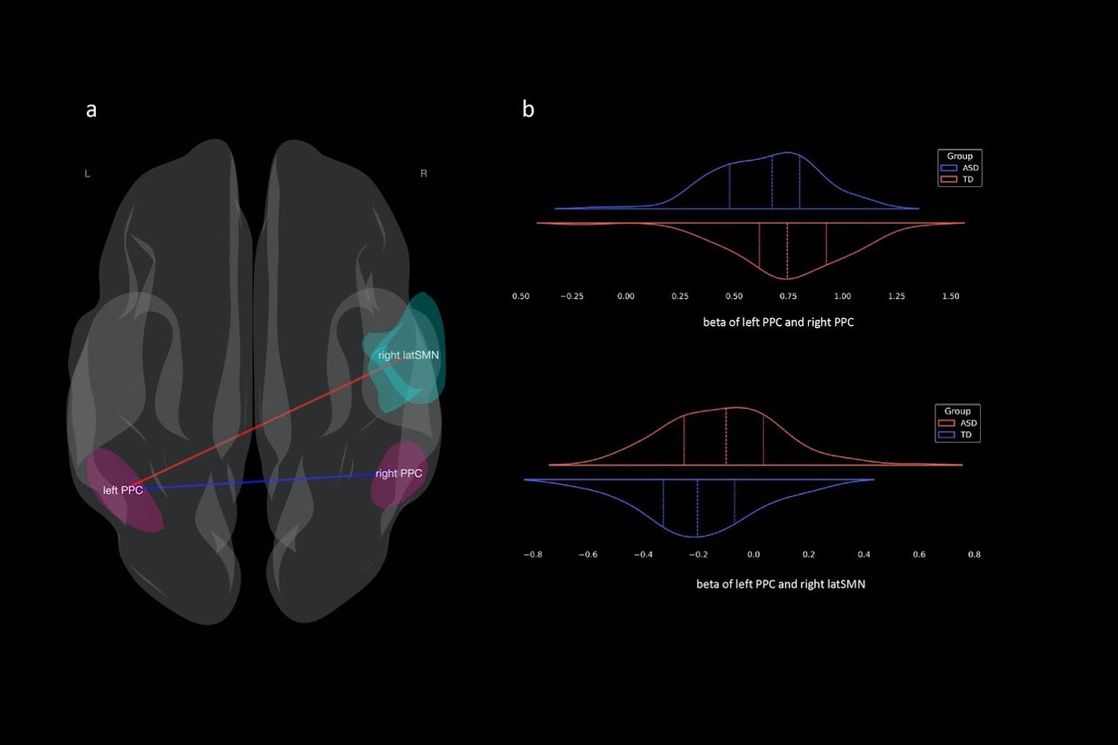
The researchers analysed fMRI data from 121 children with ASD and 84 typically developing children, aged 5 to 14, and also administered four behavioural questionnaires to assess how the children interact with others, regulate their thoughts and actions, shift attention, and control their movements.
The study found that children with ASD have significantly weaker connections within the cognitive control network. The weaker the connections, the greater the difficulty the child experienced in regulating behaviour and shifting attention—findings that were also confirmed by the behavioural test results.
At the same time, the connections between the cognitive control network and the sensorimotor network were found to be excessively strong. This characteristic was associated with difficulties in social interaction and behaviour. However, neither stronger nor weaker connectivity affected the child’s ability to control their movements.

Alina Minnigulova
'In children with autism, the balance between autonomous functioning of networks and their interaction is disrupted. Rather than smooth internal coordination, excessive cross-activity occurs, hindering the brain’s ability to adapt when switching between external and internal signals,' explains Alina Minnigulova, Research Fellow at the HSE Centre for Language and Brain.
Importantly, these deviations are not only observable on fMRI but also correlate with specific manifestations of the disorder, such as communication difficulties, attention deficits, and problems with planning and task switching. These findings will advance our understanding of the neurophysiological mechanisms underlying ASD and may, in the future, support faster diagnosis of these conditions.

See also:

Scientists Develop Algorithm for More Reliable Processors in Data Centres
Researchers from HSE MIEM and Samara University have developed the LRF-3D algorithm to automatically bypass idle nodes in three-dimensional networks-on-chip. Thanks to its hierarchical architecture, the algorithm outperforms existing solutions in both speed and path accuracy, improving processor reliability for use in data centres, supercomputers, and AI computing. The source code and test results are publicly available.
Researchers Rank Recommendation Algorithms Using Sports Tournament Model
Researchers from the AI and Digital Science Institute at the HSE Faculty of Computer Science have developed an approach for selecting recommendation algorithms more effectively. Their approach uses pairwise comparisons of algorithms to create a tournament table, with the overall ranking based on their performance across all datasets in the tournament. This can reduce the number of algorithms that need to be tested when developing new services, saving both time and money. The study was presented at the 32nd ACM SIGKDD Conference on Knowledge Discovery and Data Mining (KDD 2026).
Researchers Develop Method for Direct Generation of Regulatory DNA
Researchers at HSE University have developed a model for generating promoters and enhancers—DNA sequences that regulate gene activity. The model works directly with DNA nucleotides, without first transforming them into a continuous numerical representation. This solution could be useful for applications in synthetic biology and gene therapy. The study results were presented at the ICLR 2026 Workshop ‘Generative AI in Genomics (Gen^2): Barriers and Frontiers.’
Researchers at HSE University and Sber Train Neural Networks to Better Predict User Preferences
The HSE FCS AI and Digital Science Institute and Sber have introduced a new architecture for recommendation systems that combines two classes of models, enabling algorithms to better predict users’ interests and needs. A preprint of the paper has been published on arxiv.org and presented at Urban ML.
Physicists Discover What Happens Inside a Stable Vortex
Large vortices with characteristic spiral arms are often observed in the atmosphere and the ocean. Physicists from HSE University have explained how these structures form and why they retain their shape. The researchers found that velocities at points located along the same vortex arc remain correlated even over long distances. At the same time, this correlation weakens rapidly with increasing distance from the vortex centre. These differences help explain the formation of spiral arms and may improve models of atmospheric and oceanic currents. The findings have been published in Physical Review Fluids.
HSE Computer Science Researchers Win Gold Medal at International Machine Learning Competition
A team comprising HSE International Laboratory of Statistical and Computational Genomics researchers Aleksei Shmelev and Nikita Chervov, 2025 graduate of the HSE Faculty of Computer Science’s Master’s programme in Data Analysis in Biology and Medicine Ivan Gevorkov, and two students from the United States achieved an outstanding result at the 2026 NeuroGolf international machine learning championship. The team won a gold medal and placed seventh overall.
‘Working with AI Solves a Wide Range of Engineering Problems’
Artificial intelligence is a working tool based on a balanced combination of algorithms and engineering. Experts and doctoral students from the HSE Moscow Institute of Electronics and Mathematics explain how AI technologies can improve an application, device, or system, and what engineering tasks are solved in the process.
‘The Peak of Stupidity’ and ‘The Valley of Despair’: HSE Economists Propose an Explanation for the Dunning–Kruger Effect
The Dunning–Kruger effect, which describes a sharp surge in self-confidence among beginners followed by an equally rapid decline as they gain experience, can be explained by the nature of the learning process and the acquisition of new knowledge. This conclusion was reached by Andrey Vorchik of the HSE Faculty of Economic Sciences together with independent researcher Murat Mamyshev. They developed a mathematical model of learning and demonstrated how subjective confidence is formed and changes as knowledge accumulates, as well as how teachers can reduce the ‘valley of despair’ experienced by learners.
Toffee and Risk: Scientists Discover Why People Who Crave Sweets Make More Impulsive Choices
Having a sweet tooth may be linked not only to eating habits but also to the way people make decisions. Researchers at HSE University have found that people with a preference for sweet foods tend to behave more impulsively—not because they want immediate rewards, but because they are less willing to tolerate uncertainty. These findings may help improve treatments for addiction. The study findings have been published in Frontiers in Psychology.
Advancing Collaboration: HSE Faculty of Computer Science and Harbin Institute of Technology Hold Joint Seminar
From July 13 to 16, 2026, the Faculty of Computer Science hosted the Russian–Sino Research Seminar on Machine Learning Applications, organised by the HSE Laboratory for Cloud and Mobile Technologies in partnership with the Harbin Institute of Technology (China). A delegation comprising seven students and three university representatives travelled to Moscow to take part in an intensive four-day programme.