

Scientists Discover How Correlated Disorder Boosts Superconductivity

Superconductivity is a unique state of matter in which electric current flows without any energy loss. In materials with defects, it typically emerges at very low temperatures and develops in several stages. An international team of scientists, including physicists from HSE MIEM, has demonstrated that when defects within a material are arranged in a specific pattern rather than randomly, superconductivity can occur at a higher temperature and extend throughout the entire material. This discovery could help develop superconductors that operate without the need for extreme cooling. The study has been published in Physical Review B.
Superconductivity is a state in which electric current flows through a material without any energy loss. In conventional conductors, part of the energy is converted into heat, but in superconductors, this does not occur—current flows freely and does not weaken. Today, superconductors are used in applications such as MRI machines, where superconducting coils generate strong magnetic fields. In the future, superconductors may also be integrated into systems that require lossless power transmission and high-speed signal processing. The challenge is that nearly all superconductors function only at temperatures below -140 °C, which limits their practical use. To make them more viable, physicists are working to raise their operating temperature and improve stability.
Researchers from the HSE MIEM Centre for Quantum Metamaterials, in collaboration with colleagues from MEPhI, MIPT, and the Federal University of Pernambuco, Brazil, have shown that superconductivity can be made more stable by controlling the placement of defects. Defects are deviations from a material’s ideal crystal lattice, such as excess or missing atoms, impurities, and distortions. They usually disrupt the movement of electrons and weaken superconductivity, but it is impossible to eliminate them entirely, especially in multicomponent materials. Rather than eliminating these imperfections, the scientists have proposed arranging them in a specific pattern. This type of defect distribution is known as correlated disorder.
Alexei Vagov
'Imagine a crowd of people moving chaotically in different directions—that’s a classic example of disorder. Now imagine the same crowd moving in a complex but coordinated pattern, like a mass dance—that illustrates correlated disorder,' says Alexei Vagov, Professor at the HSE Tikhonov Moscow Institute of Electronics and Mathematics. 'In superconductors, it turns out that this kind of order within disorder causes defects to actually enhance superconductivity.'
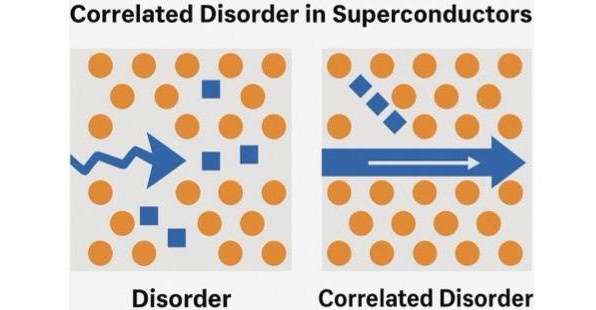
In materials with defects, superconductivity typically develops in two stages. First, isolated regions appear where superconductivity begins to emerge. Then, as the temperature drops, these regions connect, allowing current to flow throughout the entire sample. Scientists have modelled a two-dimensional superconductor with varying defect distributions—from random to correlated, where impurities are interconnected. The results show that when disorder in the material is coordinated rather than chaotic, the transition happens immediately: superconductivity emerges simultaneously throughout the entire system.
The scientists believe these findings could aid in the development of thin superconducting films, whose structures closely resemble the model used in the study. When synthesising such films, it is possible to control the placement of defects in advance, which is useful both for testing the theory and for creating materials with specified properties.
'Controlling the placement of defects at the microscopic level could enable the creation of superconductors that operate at much higher temperatures—potentially even at room temperature. This would transform superconductivity from a laboratory rarity into a technology used in everyday devices,' comments Alexei Vagov.
The study was conducted with support from the Ministry of Education and Science, Grant 075-15-2025-010, and HSE University's Basic Research Programme within the framework of the Centres of Excellence project.

See also:

Physicists Discover What Happens Inside a Stable Vortex
Large vortices with characteristic spiral arms are often observed in the atmosphere and the ocean. Physicists from HSE University have explained how these structures form and why they retain their shape. The researchers found that velocities at points located along the same vortex arc remain correlated even over long distances. At the same time, this correlation weakens rapidly with increasing distance from the vortex centre. These differences help explain the formation of spiral arms and may improve models of atmospheric and oceanic currents. The findings have been published in Physical Review Fluids.
HSE Computer Science Researchers Win Gold Medal at International Machine Learning Competition
A team comprising HSE International Laboratory of Statistical and Computational Genomics researchers Aleksei Shmelev and Nikita Chervov, 2025 graduate of the HSE Faculty of Computer Science’s Master’s programme in Data Analysis in Biology and Medicine Ivan Gevorkov, and two students from the United States achieved an outstanding result at the 2026 NeuroGolf international machine learning championship. The team won a gold medal and placed seventh overall.
‘Working with AI Solves a Wide Range of Engineering Problems’
Artificial intelligence is a working tool based on a balanced combination of algorithms and engineering. Experts and doctoral students from the HSE Moscow Institute of Electronics and Mathematics explain how AI technologies can improve an application, device, or system, and what engineering tasks are solved in the process.
‘The Peak of Stupidity’ and ‘The Valley of Despair’: HSE Economists Propose an Explanation for the Dunning–Kruger Effect
The Dunning–Kruger effect, which describes a sharp surge in self-confidence among beginners followed by an equally rapid decline as they gain experience, can be explained by the nature of the learning process and the acquisition of new knowledge. This conclusion was reached by Andrey Vorchik of the HSE Faculty of Economic Sciences together with independent researcher Murat Mamyshev. They developed a mathematical model of learning and demonstrated how subjective confidence is formed and changes as knowledge accumulates, as well as how teachers can reduce the ‘valley of despair’ experienced by learners.
Toffee and Risk: Scientists Discover Why People Who Crave Sweets Make More Impulsive Choices
Having a sweet tooth may be linked not only to eating habits but also to the way people make decisions. Researchers at HSE University have found that people with a preference for sweet foods tend to behave more impulsively—not because they want immediate rewards, but because they are less willing to tolerate uncertainty. These findings may help improve treatments for addiction. The study findings have been published in Frontiers in Psychology.
Advancing Collaboration: HSE Faculty of Computer Science and Harbin Institute of Technology Hold Joint Seminar
From July 13 to 16, 2026, the Faculty of Computer Science hosted the Russian–Sino Research Seminar on Machine Learning Applications, organised by the HSE Laboratory for Cloud and Mobile Technologies in partnership with the Harbin Institute of Technology (China). A delegation comprising seven students and three university representatives travelled to Moscow to take part in an intensive four-day programme.
Physicists Find a Way to Model Ion Parameters in Plasma in Seconds
Researchers from HSE University and the Moscow Institute of Physics and Technology (MIPT) have developed a set of simple analytical methods for calculating the properties of heavy ions in helium under the influence of a strong electric field. The new approach speeds up calculations of ion mobility and ion–molecule reaction rates by thousands of times while maintaining sufficient accuracy for plasma jet modelling. The findings have been published in the journal Physica Scripta.
A New Section on AI and a Prizewinning Paper: Early-Career HSE Researchers Take Part in IEEE EDM Conference
The 27th IEEE International Conference of Young Professionals in Electron Devices and Materials (EDM) has taken place in the Altai Republic. This year, researchers from HSE University presented the results of their research and were involved in organising a new section on artificial intelligence. A paper by HSE master’s student Rodion Sidorenko was awarded third place in the research paper competition at the conference.
Two Years of Growth or Decline: How to Choose an Investment Strategy
Economists from HSE University, together with colleagues from international universities, have analysed stock market movements over almost a century and proposed an investment strategy that could have delivered returns nearly twice as high as the market average. Their research suggests following a momentum strategy during periods of sustained market growth and switching to a value strategy after prolonged market declines. The study has been published in the Journal of Banking and Finance.
Researchers Reveal Link Between Attention and Communication Difficulties in Autism
Researchers at HSE University have examined how communication difficulties in children with autism are related to brain function. The findings show that not only language networks but also attention networks play an important role. The weaker the connections involved in maintaining focus and switching attention, the more pronounced communication difficulties were. The study has been published in European Child & Adolescent Psychiatry.