

Scientists Develop New Method to Detect Motor Disorders Using 3D Objects

Researchers at HSE University have developed a new methodological approach to studying motor planning and execution. By using 3D-printed objects and an infrared tracking system, they demonstrated that the brain initiates the planning process even before movement begins. This approach may eventually aid in the assessment and treatment of patients with neurodegenerative diseases such as Parkinson’s. The paper has been published in Frontiers in Human Neuroscience.
When a person picks up a cup or fastens a button, the brain plans the movement in advance—a process known as motor planning. This is especially important for complex actions, such as when an object must not only be lifted but also rotated. In patients with stroke or Parkinson’s disease, this mechanism is often impaired, making it essential to understand its structure for effective rehabilitation.
In earlier studies, researchers relied on reactions to visual stimuli, EEG, or MRI to investigate motor planning. However, these methods could not precisely distinguish between the planning phase and the execution of movement. Moreover, most experiments involved familiar objects, making it difficult to rule out the influence of habits and prior associations.
Scientists at the HSE Centre for Cognition and Decision Making have developed a new methodological framework for studying motor planning in the brain. In the experiment, 21 participants performed a series of tasks involving the grasping and placement of 3D-printed objects. Each of the four objects was an abstract geometric shape, unrelated to everyday items, thereby eliminating the influence of habit. The task required participants to grasp an object, rotate it if necessary, and place it precisely onto a corresponding cardboard plate.
In the experiment, four rotation angles were tested: 0°, 90°, 180°, and 270°. High-precision motion tracking was carried out using infrared cameras. Each movement was segmented into phases, from the moment the occlusion glasses opened to the completion of object placement. This approach enabled the researchers to examine in detail how motion parameters change as task complexity increases.
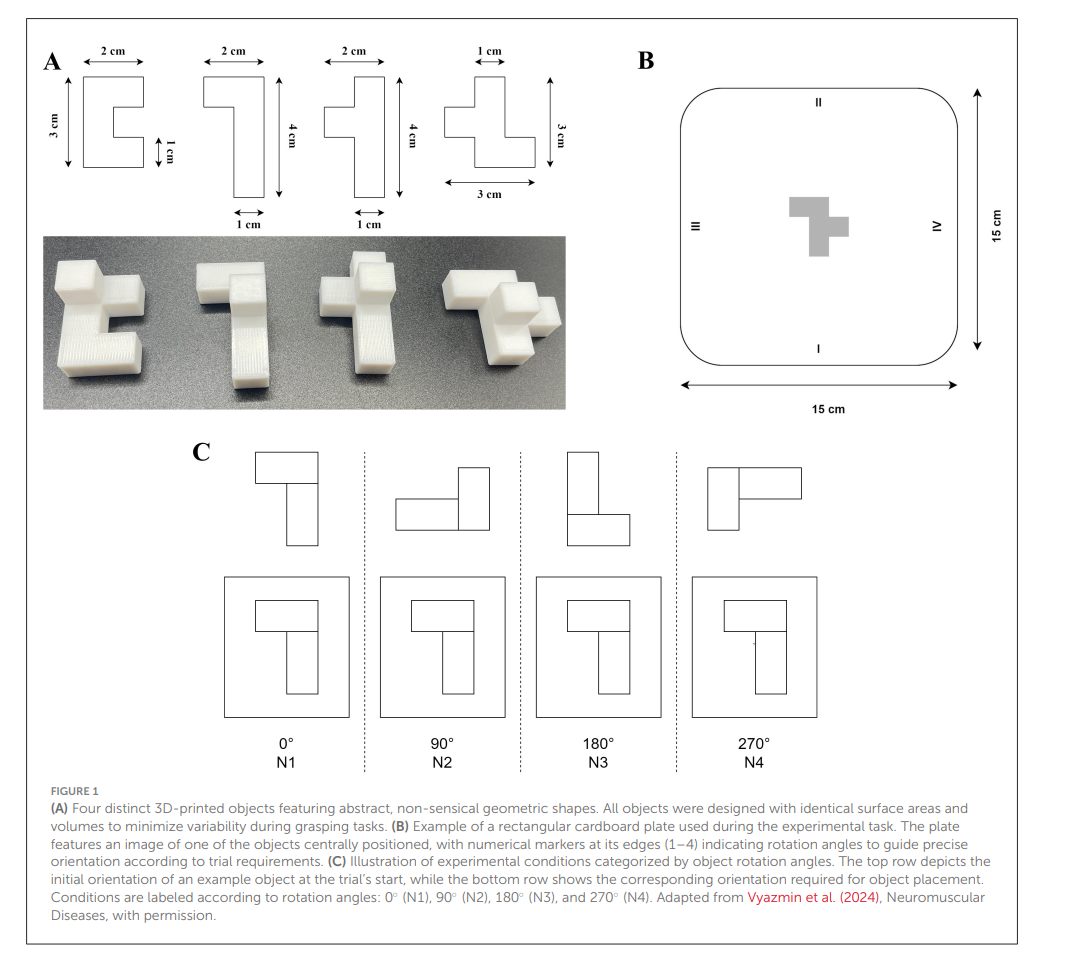
The study found that rotation had a significant impact on motion planning: movements involving rotation had longer initiation times, larger grasp apertures, and longer wrist trajectories compared to non-rotated movements. Symmetrical 180° rotations were executed faster than asymmetrical 90° and 270° rotations. These results indicate that not only task complexity but also movement geometry influences planning. Thus, motor planning is not merely a simple response to a stimulus but a distinct movement phase shaped by the demands of the task.

Matteo Feurra
The developed methodological framework may prove valuable not only for basic research but also for clinical practice. Clearly separating the planning and execution phases can lead to more accurate diagnoses and more effective rehabilitation for patients with motor disorders after stroke or other neurological conditions. 'The infrared motion tracking system fits into a portable case and can be used in clinics, sports science, or field research. Most importantly, it enables the detection of subtle delays in motor planning, which may serve as early indicators of neurological disorders,' explains Matteo Feurra, Leading Research Fellow at the HSE Centre for Cognition and Decision Making and one of the authors of the study.
The study was carried out within the framework of the HSE Basic Research Programme.

See also:

Researchers Develop Method for Direct Generation of Regulatory DNA
Researchers at HSE University have developed a model for generating promoters and enhancers—DNA sequences that regulate gene activity. The model works directly with DNA nucleotides, without first transforming them into a continuous numerical representation. This solution could be useful for applications in synthetic biology and gene therapy. The study results were presented at the ICLR 2026 Workshop ‘Generative AI in Genomics (Gen^2): Barriers and Frontiers.’
Researchers at HSE University and Sber Train Neural Networks to Better Predict User Preferences
The HSE FCS AI and Digital Science Institute and Sber have introduced a new architecture for recommendation systems that combines two classes of models, enabling algorithms to better predict users’ interests and needs. A preprint of the paper has been published on arxiv.org and presented at Urban ML.
Physicists Discover What Happens Inside a Stable Vortex
Large vortices with characteristic spiral arms are often observed in the atmosphere and the ocean. Physicists from HSE University have explained how these structures form and why they retain their shape. The researchers found that velocities at points located along the same vortex arc remain correlated even over long distances. At the same time, this correlation weakens rapidly with increasing distance from the vortex centre. These differences help explain the formation of spiral arms and may improve models of atmospheric and oceanic currents. The findings have been published in Physical Review Fluids.
HSE Computer Science Researchers Win Gold Medal at International Machine Learning Competition
A team comprising HSE International Laboratory of Statistical and Computational Genomics researchers Aleksei Shmelev and Nikita Chervov, 2025 graduate of the HSE Faculty of Computer Science’s Master’s programme in Data Analysis in Biology and Medicine Ivan Gevorkov, and two students from the United States achieved an outstanding result at the 2026 NeuroGolf international machine learning championship. The team won a gold medal and placed seventh overall.
‘Working with AI Solves a Wide Range of Engineering Problems’
Artificial intelligence is a working tool based on a balanced combination of algorithms and engineering. Experts and doctoral students from the HSE Moscow Institute of Electronics and Mathematics explain how AI technologies can improve an application, device, or system, and what engineering tasks are solved in the process.
‘The Peak of Stupidity’ and ‘The Valley of Despair’: HSE Economists Propose an Explanation for the Dunning–Kruger Effect
The Dunning–Kruger effect, which describes a sharp surge in self-confidence among beginners followed by an equally rapid decline as they gain experience, can be explained by the nature of the learning process and the acquisition of new knowledge. This conclusion was reached by Andrey Vorchik of the HSE Faculty of Economic Sciences together with independent researcher Murat Mamyshev. They developed a mathematical model of learning and demonstrated how subjective confidence is formed and changes as knowledge accumulates, as well as how teachers can reduce the ‘valley of despair’ experienced by learners.
Toffee and Risk: Scientists Discover Why People Who Crave Sweets Make More Impulsive Choices
Having a sweet tooth may be linked not only to eating habits but also to the way people make decisions. Researchers at HSE University have found that people with a preference for sweet foods tend to behave more impulsively—not because they want immediate rewards, but because they are less willing to tolerate uncertainty. These findings may help improve treatments for addiction. The study findings have been published in Frontiers in Psychology.
Advancing Collaboration: HSE Faculty of Computer Science and Harbin Institute of Technology Hold Joint Seminar
From July 13 to 16, 2026, the Faculty of Computer Science hosted the Russian–Sino Research Seminar on Machine Learning Applications, organised by the HSE Laboratory for Cloud and Mobile Technologies in partnership with the Harbin Institute of Technology (China). A delegation comprising seven students and three university representatives travelled to Moscow to take part in an intensive four-day programme.
Physicists Find a Way to Model Ion Parameters in Plasma in Seconds
Researchers from HSE University and the Moscow Institute of Physics and Technology (MIPT) have developed a set of simple analytical methods for calculating the properties of heavy ions in helium under the influence of a strong electric field. The new approach speeds up calculations of ion mobility and ion–molecule reaction rates by thousands of times while maintaining sufficient accuracy for plasma jet modelling. The findings have been published in the journal Physica Scripta.
A New Section on AI and a Prizewinning Paper: Early-Career HSE Researchers Take Part in IEEE EDM Conference
The 27th IEEE International Conference of Young Professionals in Electron Devices and Materials (EDM) has taken place in the Altai Republic. This year, researchers from HSE University presented the results of their research and were involved in organising a new section on artificial intelligence. A paper by HSE master’s student Rodion Sidorenko was awarded third place in the research paper competition at the conference.