

Scientists Develop AI Tool for Designing Novel Materials

An international team of scientists, including researchers from HSE University, has developed a new generative model called the Wyckoff Transformer (WyFormer) for creating symmetrical crystal structures. The neural network will make it possible to design materials with specified properties for use in semiconductors, solar panels, medical devices, and other high-tech applications. The scientists will present their work at ICML, a leading international conference on machine learning, on July 15 in Vancouver. A preprint of the paper is available on arxiv.org, with the code and data released under an open-source license.
New materials form the foundation of modern technologies, from electronics to medicine. Thanks to AI, the development timeline for novel materials has been reduced from decades to just a few months. However, scientists must not only rapidly generate new compounds but also accurately predict their properties—such as whether the material will conduct electricity or be durable.
The properties of a material are primarily determined by the internal symmetry of the crystals that compose nearly all solid substances. However, many modern generative models do not explicitly account for symmetry.
Researchers from HSE University, the National University of Singapore, Nanyang Technological University, and Constructor University have developed the Wyckoff Transformer (WyFormer), a novel machine-learning algorithm that rapidly generates materials with specified symmetries and predicts their stability and performance.
The model is based on representing a crystal using Wyckoff positions—mathematically precise coordinates that specify where atoms can be located based on crystal lattice symmetry. This approach enables a concise and universal representation of the structure
'Imagine your reflection in a mirror. While our face is symmetrical, some features come in pairs belonging to two distinct classes, such as the right and left eyes. Other features belong to a single class, like the tip of the nose. In mathematical terms, the nose corresponds to Wyckoff position A, while the eye corresponds to Wyckoff position B. In other words, Wyckoff positions are the key points that define symmetry and enable us to recognise a human face in the mirror,' explains Ignat Romanov, co-author of the paper and Junior Research Fellow at the Faculty of Computer Science, HSE University.
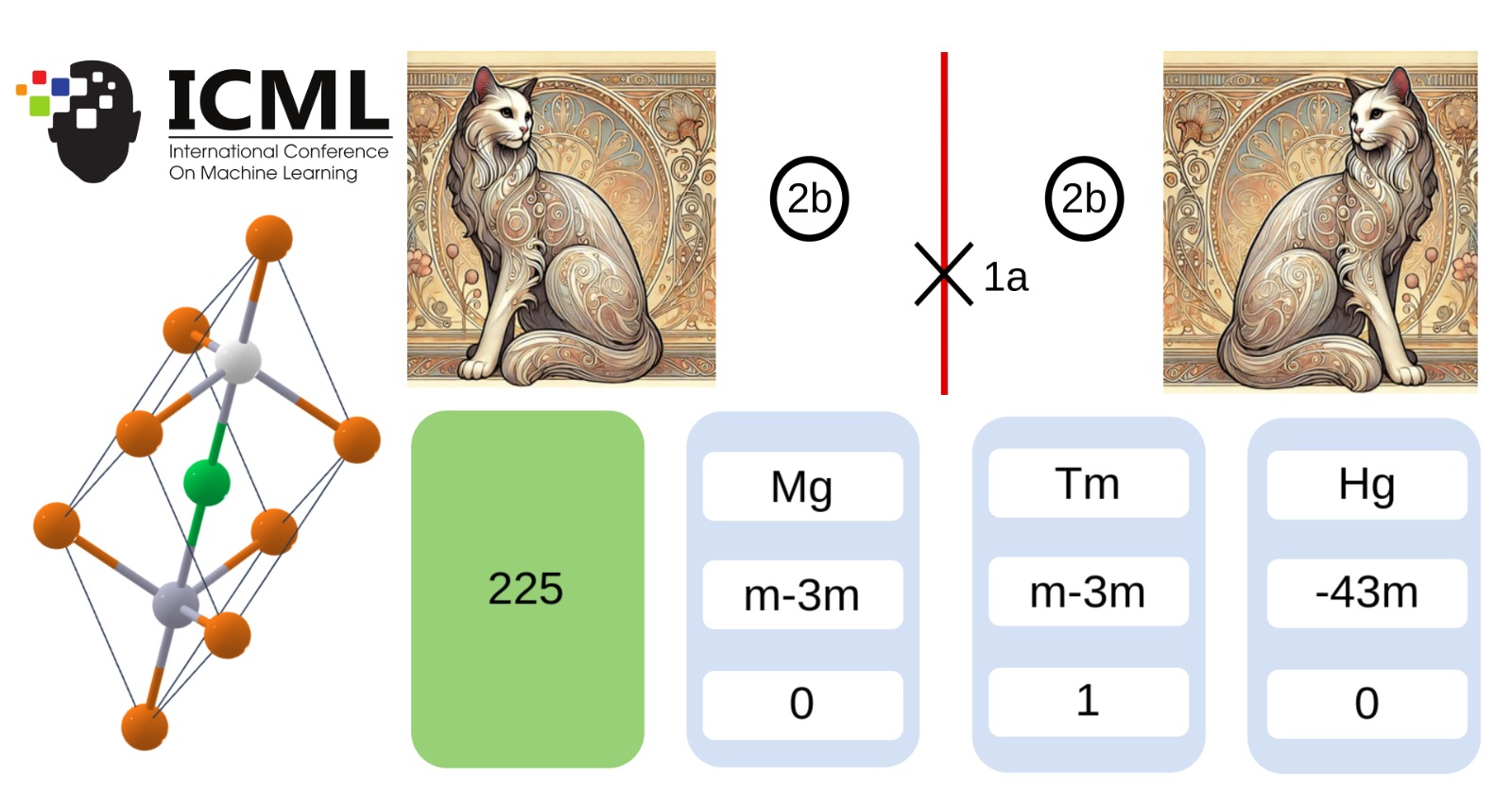
The new model was trained on an open database of real materials from the Materials Project. The AI leverages a transformer architecture to generate novel crystal synthesis recipes that automatically conform to symmetry rules.
'There are countless ways atoms can combine. Trying to find useful combinations and design new materials without understanding their symmetry rules is like sticking LEGO blocks together without a plan. While such improvisation may occasionally produce interesting results, it often leads to unstable structures,' says Nikita Kazeev, co-author of the paper, Research Fellow at the Institute for Functional Intelligent Materials (I-FIM), National University of Singapore, and graduate of the HSE Faculty of Computer Science. 'Our AI tool has effectively learned from all good LEGO instructions—it knows how to generate models that are stable, aesthetically pleasing, and functional. Returning from the metaphor to materials, it understands the full range of symmetry options and can predict a material's properties even without knowing the exact atomic positions within the unit cell.'
Compared to other models, WyFormer produces a higher proportion of stable and unique structures, generates crystals with more accurate symmetry, and achieves a generation rate an order of magnitude faster.
The researchers plan to apply the model to develop practical materials for solid electrolytes and materials with specified thermal conductivity.

Ignat Romanov
See also:

Scientists Develop Algorithm for More Reliable Processors in Data Centres
Researchers from HSE MIEM and Samara University have developed the LRF-3D algorithm to automatically bypass idle nodes in three-dimensional networks-on-chip. Thanks to its hierarchical architecture, the algorithm outperforms existing solutions in both speed and path accuracy, improving processor reliability for use in data centres, supercomputers, and AI computing. The source code and test results are publicly available.
Researchers Rank Recommendation Algorithms Using Sports Tournament Model
Researchers from the AI and Digital Science Institute at the HSE Faculty of Computer Science have developed an approach for selecting recommendation algorithms more effectively. Their approach uses pairwise comparisons of algorithms to create a tournament table, with the overall ranking based on their performance across all datasets in the tournament. This can reduce the number of algorithms that need to be tested when developing new services, saving both time and money. The study was presented at the 32nd ACM SIGKDD Conference on Knowledge Discovery and Data Mining (KDD 2026).
Researchers Develop Method for Direct Generation of Regulatory DNA
Researchers at HSE University have developed a model for generating promoters and enhancers—DNA sequences that regulate gene activity. The model works directly with DNA nucleotides, without first transforming them into a continuous numerical representation. This solution could be useful for applications in synthetic biology and gene therapy. The study results were presented at the ICLR 2026 Workshop ‘Generative AI in Genomics (Gen^2): Barriers and Frontiers.’
Researchers at HSE University and Sber Train Neural Networks to Better Predict User Preferences
The HSE FCS AI and Digital Science Institute and Sber have introduced a new architecture for recommendation systems that combines two classes of models, enabling algorithms to better predict users’ interests and needs. A preprint of the paper has been published on arxiv.org and presented at Urban ML.
HSE Graduate School of Business and Alfa-Bank Hold Summer School for Students from China
Twenty-seven students from Chinese universities took part in the international summer school ‘Digital Product Management’ organised by the HSE Graduate School of Business and Alfa-Bank. Over the course of a week, participants explored the Russian economy and business environment, learned about current technology trends, and worked through the key stages of digital product development step by step—from researching user needs and defining a problem to developing a prototype and presenting their final project.
Physicists Discover What Happens Inside a Stable Vortex
Large vortices with characteristic spiral arms are often observed in the atmosphere and the ocean. Physicists from HSE University have explained how these structures form and why they retain their shape. The researchers found that velocities at points located along the same vortex arc remain correlated even over long distances. At the same time, this correlation weakens rapidly with increasing distance from the vortex centre. These differences help explain the formation of spiral arms and may improve models of atmospheric and oceanic currents. The findings have been published in Physical Review Fluids.
HSE Computer Science Researchers Win Gold Medal at International Machine Learning Competition
A team comprising HSE International Laboratory of Statistical and Computational Genomics researchers Aleksei Shmelev and Nikita Chervov, 2025 graduate of the HSE Faculty of Computer Science’s Master’s programme in Data Analysis in Biology and Medicine Ivan Gevorkov, and two students from the United States achieved an outstanding result at the 2026 NeuroGolf international machine learning championship. The team won a gold medal and placed seventh overall.
‘Working with AI Solves a Wide Range of Engineering Problems’
Artificial intelligence is a working tool based on a balanced combination of algorithms and engineering. Experts and doctoral students from the HSE Moscow Institute of Electronics and Mathematics explain how AI technologies can improve an application, device, or system, and what engineering tasks are solved in the process.
‘The Peak of Stupidity’ and ‘The Valley of Despair’: HSE Economists Propose an Explanation for the Dunning–Kruger Effect
The Dunning–Kruger effect, which describes a sharp surge in self-confidence among beginners followed by an equally rapid decline as they gain experience, can be explained by the nature of the learning process and the acquisition of new knowledge. This conclusion was reached by Andrey Vorchik of the HSE Faculty of Economic Sciences together with independent researcher Murat Mamyshev. They developed a mathematical model of learning and demonstrated how subjective confidence is formed and changes as knowledge accumulates, as well as how teachers can reduce the ‘valley of despair’ experienced by learners.
Toffee and Risk: Scientists Discover Why People Who Crave Sweets Make More Impulsive Choices
Having a sweet tooth may be linked not only to eating habits but also to the way people make decisions. Researchers at HSE University have found that people with a preference for sweet foods tend to behave more impulsively—not because they want immediate rewards, but because they are less willing to tolerate uncertainty. These findings may help improve treatments for addiction. The study findings have been published in Frontiers in Psychology.