

HSE and Communication University of Zhejiang Strengthen Partnership in Creative Education
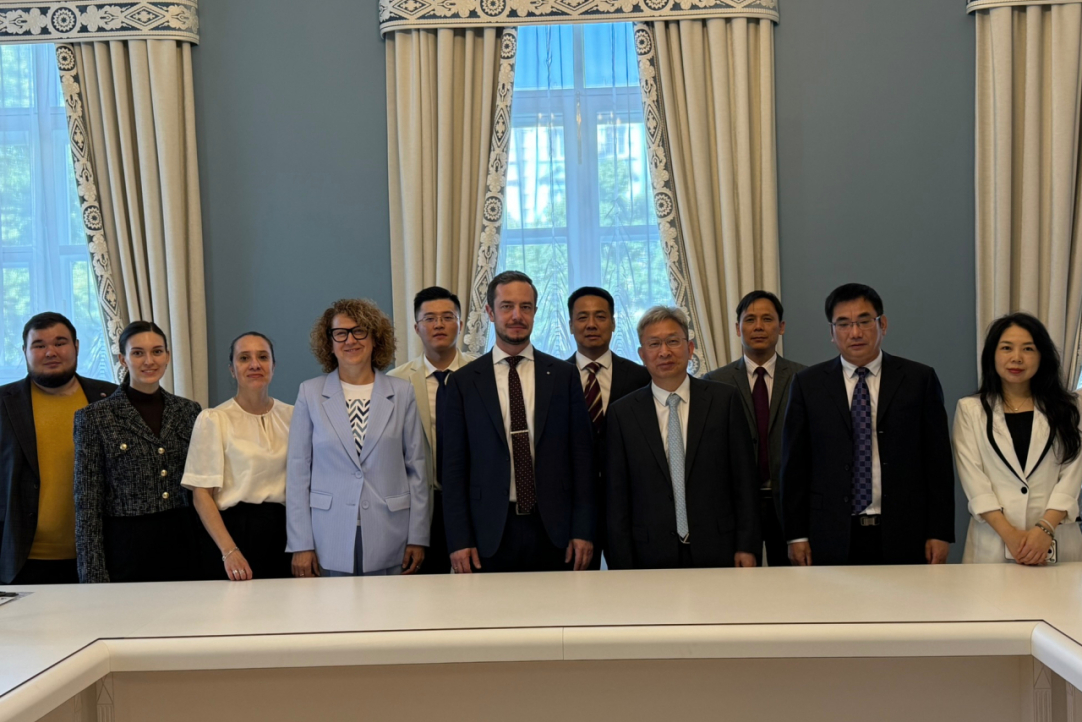
On July 7, 2025, HSE University hosted a delegation from China at the historic Durasov House. The delegation, led by Wei Guotan, Chair of the University Council of Communication University of Zhejiang (CUZ), was welcomed by HSE Vice Rector Dmitry Zemtsov, Deputy Dean of the Faculty of Creative Industries Tatiana Rivchun, and representatives of the HSE Institute for Creative Industries Development and the HSE Art and Design School—the initiators of the partnership with their Chinese colleagues.
The visit focused on the further development of collaboration between the two universities. They already have experience of cooperation through academic and practical seminars on building global careers in the creative industries, as well as expert involvement in the HSE Creative Open competitions.
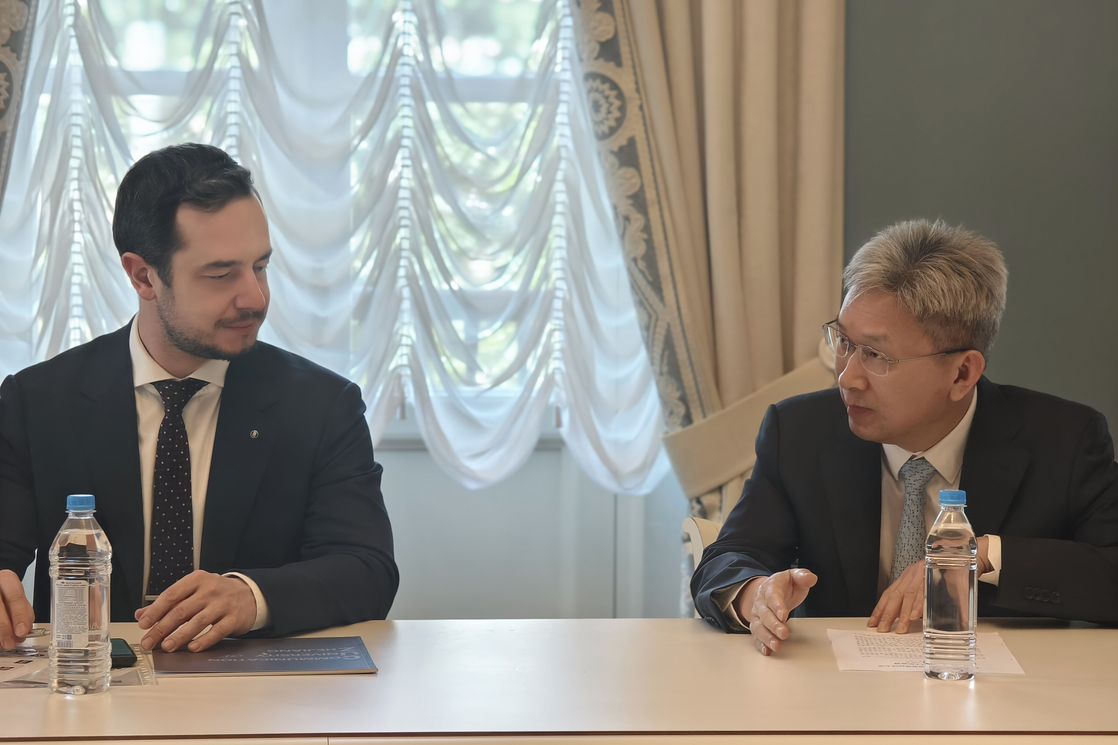
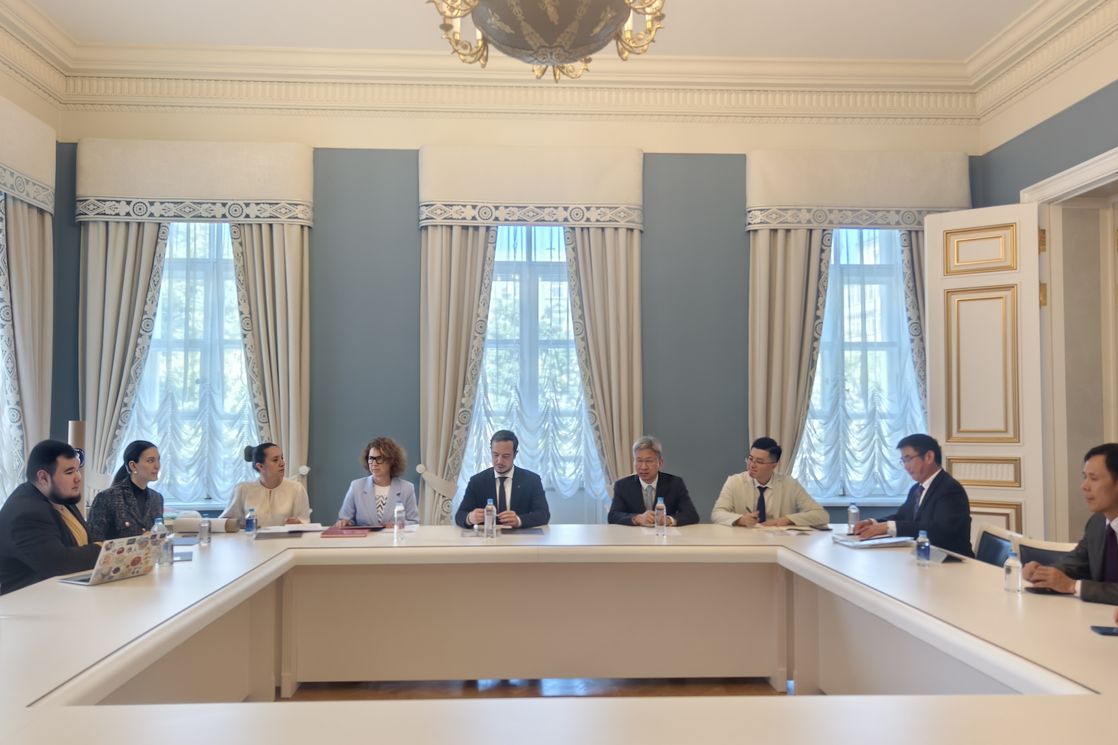
At the opening of the meeting, Dmitry Zemtsov highlighted the importance of developing international partnerships for HSE University, which ranks among the world’s top 100 universities in several subject areas according to the QS World University Rankings by Subject. The vice rector emphasised the value of cooperation in implementing initiatives to support young professionals, including international competitions. He also noted the significant contribution that CUZ—with its extensive expertise in contemporary media, communications, and design—could make to the work of the HSE Art and Design School and the Institute for Creative Industries Development.
‘HSE University offers double degree undergraduate and master’s programmes in partnership with world-class universities. We look forward to building on our existing ties through new joint projects, competitions, and postgraduate educational programmes,’ said Dmitry Zemtsov.
In his response, Wei Guotan stressed the importance of collaboration with HSE University for CUZ, one of China’s leading universities in the field of communications. Founded in 1978 through a joint initiative by the Zhejiang provincial government and the National Radio and Television Administration, CUZ has two campuses in Hangzhou and Tongxiang. The university has partnerships with over 150 international institutions, and many of its students continue their studies abroad.
‘We are interested in academic exchange for both students and faculty, as well as in developing joint educational programmes, and we would be glad to welcome representatives of HSE University to our institution,’ Mr Wei said in his speech.
Tatiana Rivchun, Deputy Dean of the Faculty of Creative Industries and Director of the Institute for Creative Industries Development, confirmed a shared readiness to cooperate across a wide range of fields within the creative industries. These are well represented at both CUZ and HSE University, not only in design and creative industries management, but also in areas especially relevant to the Chinese side—journalism, television and radio broadcasting, cinema, music, and more.
‘A key feature of contemporary education in the creative industries is its project-oriented nature,’ Tatiana Rivchun emphasised. ‘At HSE, this approach is supported by our digital platform, which our Chinese colleagues have already encountered through their participation in the HSE Creative Open competition jury.’ The platform—hse.space—offers digital portfolios and related services that have extended beyond the faculty, the university, and even the country.
‘Our Creative City platform, which showcases projects tied to specific locations—cities and places on the map—helps our institute and school to compile a database of best practices aimed at enhancing urban appeal and engaging with local heritage. We are pleased that it already features projects from a variety of countries, and we look forward to increasing the number of Chinese and joint projects represented,’ Tatiana Rivchun added.
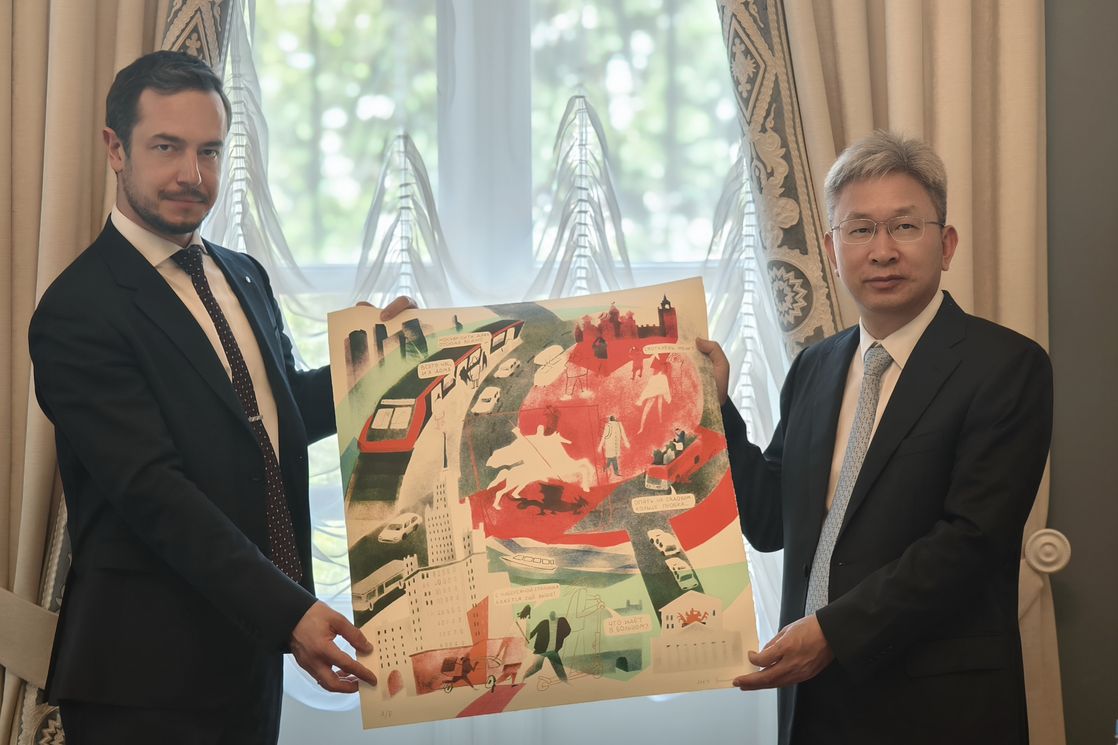
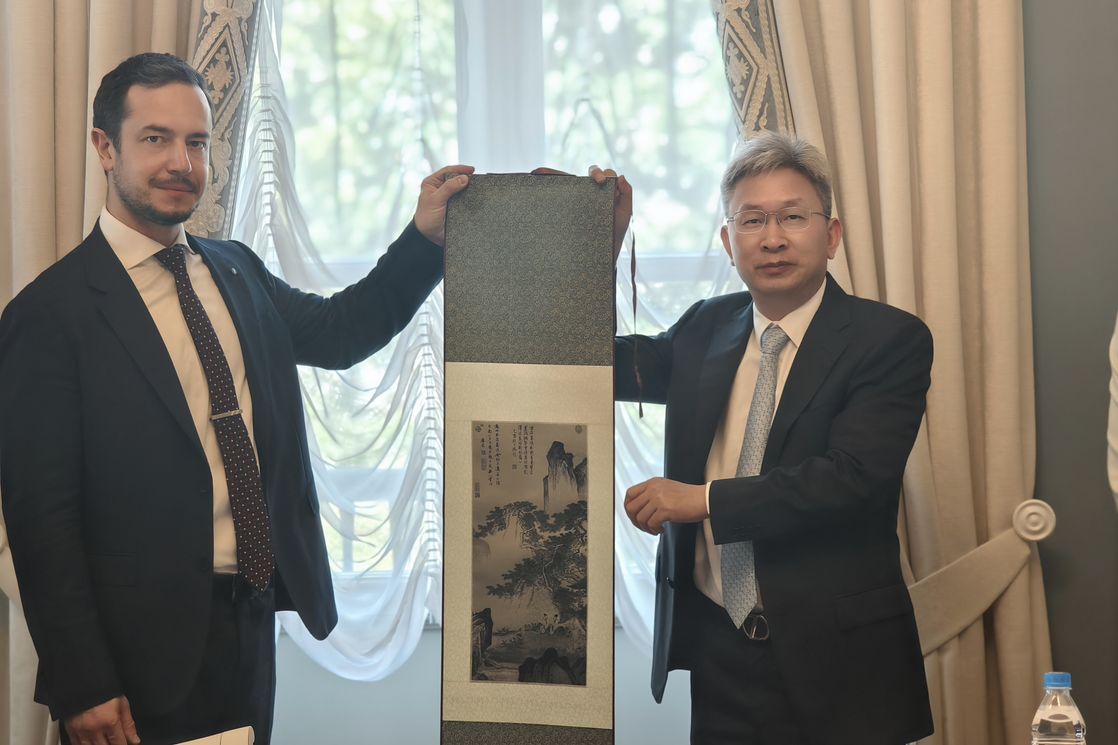
The parties exchanged gifts. HSE University presented images and an original print—a stylised view of Moscow—from the HSE Cities Collection illustration series by Alexandra Yeremina, student of the Art and Design School. The collection features all of HSE’s campuses. In return, Wei Guotan presented an original print in the style of traditional Chinese woodcut.
First, the Chinese delegation had a guided tour of Durasov House, where the guests learned about the historical, architectural, and cultural significance of the heritage site. They then explored HSE’s educational environment further at the Art and Design School and the Institute for Creative Industries Development on 12 Malaya Pionerskaya Street. There, the delegation visited lecture rooms and computer labs, explored studios, the Design Lab, shop, and gallery—all spaces that illustrate the transition from education to professional, commercial, and creative application in modern creative education. At the close of the visit, the Chinese colleagues reiterated their interest in continuing joint work through the portfolio platform and competition framework, and in discussing shared educational programmes and academic exchanges.

See also:

Biologists Discover 'Molecular Fingerprint' of Preeclampsia
Researchers at HSE University employed a new method to model hypoxia in placental cells during pregnancies complicated by preeclampsia and identified molecular markers of tissue hypoxia. Since hypoxia is one of the key mechanisms underlying preeclampsia, these findings are important for a more accurate and timely diagnosis of the disease and for the development of effective treatment methods. The paper has been published in Placenta.
‘Hedgehog’ Versus ‘Relatives’: Researchers Measure How the Brain Responds to Unexpected Words During Natural Speech
Russian neurophysiologists, including researchers from HSE University, have demonstrated the feasibility of using event-related fields (ERFs) to study brain activity during natural speech perception. The researchers showed that this approach can be applied not only to individual words but also to continuous speech. Their findings indicate that words whose meanings differ significantly from the preceding context require longer processing times. The study also reveals that the brain processes function words in two stages: first, it identifies their grammatical role and then uses this information to predict the next word. The study has been published in Frontiers in Human Neuroscience.
Hybrid Intelligence: Competencies in the Age of AI Discussed at Technoprom-2026
Artificial intelligence is not creating new professions, but rather transforming the nature of existing ones. This was the conclusion reached by participants in the panel session ‘Hybrid Intelligence: Digital and Human Drivers of Development,’ organised by the Institute for Statistical Studies and Economics of Knowledge (ISSEK) at HSE University as part of the 13th International Forum of Technological Development (Technoprom-2026). The experts discussed how the nature of work is changing, which skills are becoming increasingly sought after, and what prevents companies from fully capitalising on new technologies.
Scientists Develop New Solution for 6G Communication Systems
A terahertz neuromorphic circuit developed by scientists at HSE University could make 6G communication systems both more accurate and energy-efficient. The circuit enables indoor tracking of mobile devices with an accuracy of up to 99%. The results were presented at PIERS 2026, an international symposium on Photonics and Electromagnetism held in China.
Researchers Develop Method for Direct Generation of Regulatory DNA
Researchers at HSE University have developed a model for generating promoters and enhancers—DNA sequences that regulate gene activity. The model works directly with DNA nucleotides, without first transforming them into a continuous numerical representation. This solution could be useful for applications in synthetic biology and gene therapy. The study results were presented at the ICLR 2026 Workshop ‘Generative AI in Genomics (Gen^2): Barriers and Frontiers.’
Researchers at HSE University and Sber Train Neural Networks to Better Predict User Preferences
The HSE FCS AI and Digital Science Institute and Sber have introduced a new architecture for recommendation systems that combines two classes of models, enabling algorithms to better predict users’ interests and needs. A preprint of the paper has been published on arxiv.org and presented at Urban ML.
HSE Graduate School of Business and Alfa-Bank Hold Summer School for Students from China
Twenty-seven students from Chinese universities took part in the international summer school ‘Digital Product Management’ organised by the HSE Graduate School of Business and Alfa-Bank. Over the course of a week, participants explored the Russian economy and business environment, learned about current technology trends, and worked through the key stages of digital product development step by step—from researching user needs and defining a problem to developing a prototype and presenting their final project.
Physicists Discover What Happens Inside a Stable Vortex
Large vortices with characteristic spiral arms are often observed in the atmosphere and the ocean. Physicists from HSE University have explained how these structures form and why they retain their shape. The researchers found that velocities at points located along the same vortex arc remain correlated even over long distances. At the same time, this correlation weakens rapidly with increasing distance from the vortex centre. These differences help explain the formation of spiral arms and may improve models of atmospheric and oceanic currents. The findings have been published in Physical Review Fluids.
HSE Computer Science Researchers Win Gold Medal at International Machine Learning Competition
A team comprising HSE International Laboratory of Statistical and Computational Genomics researchers Aleksei Shmelev and Nikita Chervov, 2025 graduate of the HSE Faculty of Computer Science’s Master’s programme in Data Analysis in Biology and Medicine Ivan Gevorkov, and two students from the United States achieved an outstanding result at the 2026 NeuroGolf international machine learning championship. The team won a gold medal and placed seventh overall.
‘Working with AI Solves a Wide Range of Engineering Problems’
Artificial intelligence is a working tool based on a balanced combination of algorithms and engineering. Experts and doctoral students from the HSE Moscow Institute of Electronics and Mathematics explain how AI technologies can improve an application, device, or system, and what engineering tasks are solved in the process.